Why do prepaid cards in Canada all look the same?
Most compete on budgeting, travel, or gifting — features, fees, and use cases. But people don’t choose products based only on features. They choose them because they satisfy underlying human motivations.
We mapped those motivations across the Canadian prepaid card market and found something surprising: the single largest customer motivation — shared by one in five consumers — is barely addressed by today’s market.
Why Existing Approaches Are Not Enough
Companies invest heavily in understanding customer needs, yet translating those needs into clear product, pricing, and marketing decisions remains difficult.
Existing approaches — including Jobs-to-be-Done, Means-End Chains, Self-Determination Theory, and identity-based motivation — each explain an important part of customer motivation. But most focus on either what customers are trying to achieve or how deeply that motivation matters. What is often missing is a practical way to combine both dimensions, measure them consistently, and use them to guide strategy.
Need Architecture
Need Architecture was developed to address this gap.
It separates customer needs into two dimensions:
- Need Domain: what the customer is ultimately seeking (such as safety, status, freedom)
- Need Level: how deeply that motivation is experienced (such as functional, emotional, identity)
The core idea: Together, Need Domain and Need Level define a customer’s Motivational Territory — the need space a product or a brand can choose to occupy. Every downstream decision—from personas and product design to pricing and customer experience—flows from the Motivational Territory an organization chooses to occupy.
Need Domains: What Customers Are Seeking
Need Domains describe the underlying motivation shaping customer demand. Examples include:
| Need Domain | What the customer is seeking |
|---|---|
| Control | “I want to feel in charge of what happens.” |
| Freedom | “I want fewer restrictions and more choices.” |
| Safety | “I want to feel protected from bad outcomes.” |
| Status | “I want others to recognize my success.” |
Most products do not operate within a single Need Domain. They typically have one Primary Domain—the dominant motivation that defines their core strategic territory—supported by one or more Secondary Domains that reinforce credibility, differentiation, or adoption.
Need Levels: How Deeply the Need Is Experienced
Customers may pursue the same Need Domain at very different levels. Levitt famously observed that people do not want a quarter-inch drill; they want a quarter-inch hole. The Need Architecture approach extends this logic further. The hole itself (the functional level of the need) may simply be a solution to a deeper need. The real need may be to hang a picture (task level), make a home feel warm and personal (emotional level), or be a good homeowner (identity level). The deeper the level, the less the product competes only on features and the more it competes on emotional outcomes, identity, and belonging.
| Need Level | Example | Strategic implication | Design approach |
|---|---|---|---|
| Functional | A drill | Most crowded, lowest margin. Compete on features and parity. | Design for specifications and reliability. |
| Task | Hang a picture | Compete on task completion, UX, and reliability. | Design for seamless flow and friction reduction. |
| Emotional | Make home feel warm | Compete on emotional outcome. Commands a premium. | Design for the feeling the customer is seeking. |
| Identity | Be a good homeowner | Most defensible. Compete on self-concept. | Design for identity reinforcement and signal. |
| Belonging / Ecosystem | Create a home others gather in | Rarest. Compete on belonging and participation. | Design for community and shared meaning. |
The Need Architecture Matrix
Need Domains and Need Levels work together to define a customer’s Motivational Territory. The example below illustrates Motivational Territories for a financial services category. Rows show what customers are trying to achieve (Need Domains); columns show how deeply that motivation is experienced (Need Levels). Each cell is a distinct territory with its own strategic implications, expressed as [Need Domain] @ [Need Level].
| Need Domain | Functional | Task | Emotional | Identity | Belonging / Ecosystem |
|---|---|---|---|---|---|
| Control | Track expenses | Manage money reliably | Feel financially stable | Be a responsible adult | Be the anchor others depend on |
| Freedom | Access money anywhere | Simplify financial life | Feel unencumbered | Be financially independent | Create freedom others admire |
| Safety | Protect against fraud | Have reliable backup | Feel financially safe | Be always prepared | Create safety for those around me |
| Status | Own premium products | Maintain high standing | Feel financially ahead | Signal financial success | Lead communities of achievers |
| Simplicity | Automate payments | Reduce complexity | Reduce financial anxiety | Be seen as effortless | Create simplicity for others |
For example, a brand might choose to compete at Control @ Emotional. That single choice shapes every downstream decision. Its competitors are brands that help customers feel financially stable, not those focused on excitement or belonging. Its value proposition, pricing, and customer experience must all reinforce that emotional promise. The Motivational Territory a brand chooses ultimately determines how it competes.
Why this matters: Customers may share the same Need Domain but occupy very different Need Levels. Treating them as a single segment masks important differences in product expectations, pricing sensitivity, and customer experience.
A customer-needs framework is only useful if it leads to better strategic decisions. The following proof of concept illustrates how Need Architecture can be used to identify underserved market opportunities.
The Proof of Concept
Prepaid Card Need Architecture
The Need Architecture Matrix is category-independent. The following illustrative example applies the same methodology to identify Motivational Territories within a specific market: prepaid cards in Canada.
About the study: The proof of concept study was fielded in May 2026 with a nationally representative Canadian sample of n = 500 respondents who indicated they would be open to a prepaid card. Need Domains were measured with a MaxDiff exercise; Need Levels were coded from AI-guided interviews conducted within the same study. Figures are directional and intended to demonstrate the methodology rather than to size the market.
Step 1 — Measure Need Domains Using MaxDiff
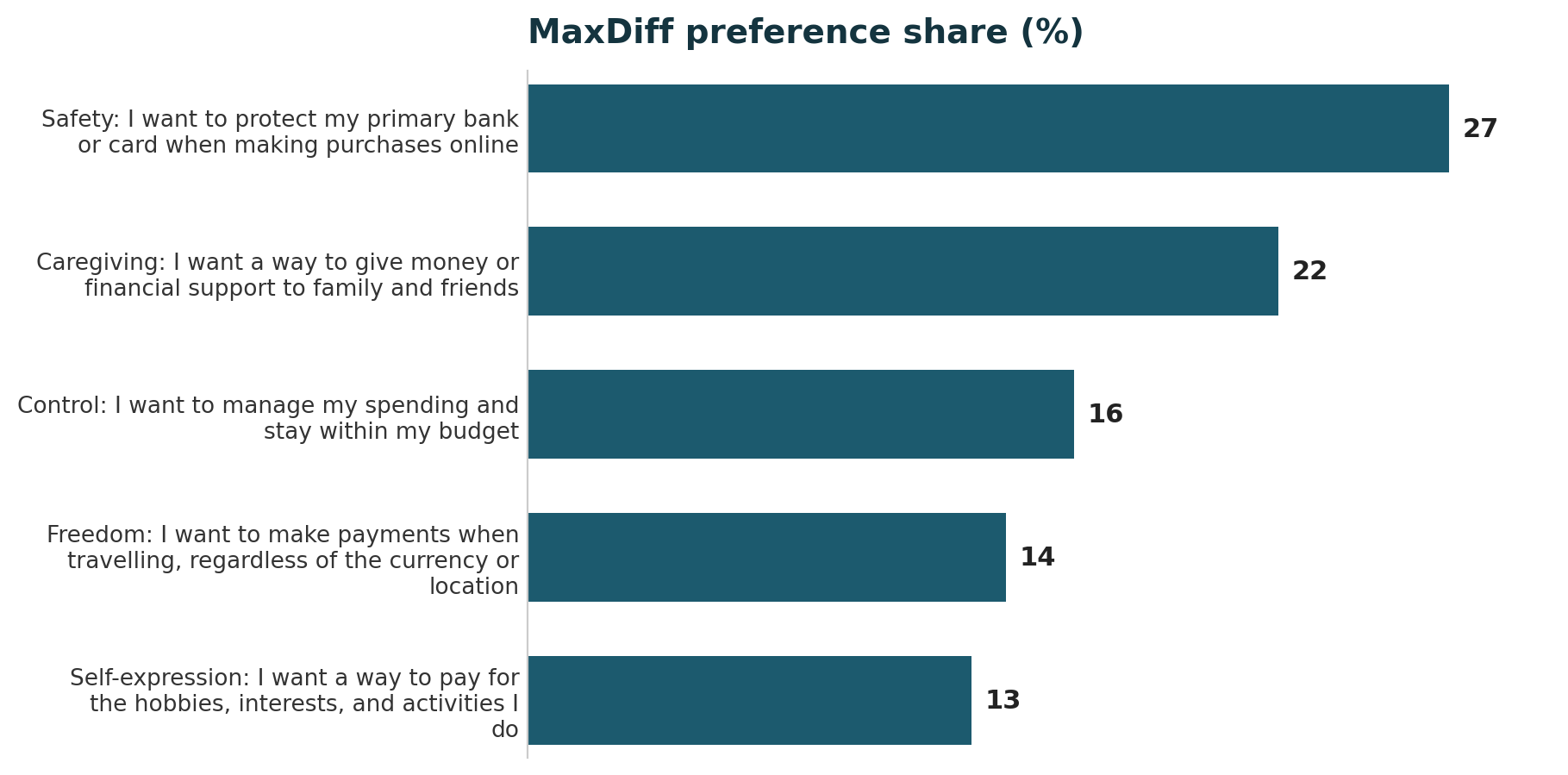
Need Architecture is built around fourteen fundamental Need Domains representing broad human motivations (see Appendix). Because these domains are universal, they must be translated into category-specific expressions before they can be measured. All Need Domain statements were intentionally written at the functional Need Level to avoid introducing Need Level bias into the MaxDiff exercise. For example, the Safety domain was expressed as “Safety: I want to protect my primary bank or card when making purchases online,” and the Control domain as “Control: I want to manage my spending and stay within my budget.”
The five leading Need Domains selected by respondents for a prepaid card were:
Step 2 — Code Need Levels from AI-Guided Interviews
The dominant Need Level was identified by coding AI-guided interviews conducted after the MaxDiff exercise. The interviews focused on the Need Domains each respondent selected most often during the MaxDiff exercise, exploring why respondents made those choices to determine the depth at which the underlying need is experienced (Functional, Task, Emotional, Identity, or Ecosystem).
Output — the Motivational Territory Map
| Need Domain | Functional | Task | Emotional | Identity | Ecosystem |
|---|---|---|---|---|---|
| Safety | 4.9% | 1.1% | 21.1% | 0.0% | 0.0% |
| Caregiving | 6.4% | 12.5% | 1.8% | 1.3% | 0.0% |
| Control | 4.0% | 9.4% | 1.3% | 1.3% | 0.0% |
| Freedom | 7.7% | 3.5% | 2.5% | 0.3% | 0.0% |
| Self-expression | 2.0% | 3.0% | 3.8% | 4.3% | 0.0% |
Viewed in order of demand, the map tells a clear story. Different Need Domains gravitate toward different Need Levels, and the largest pockets of demand are concentrated in a handful of cells.
Safety @ Emotional (21.1%) — by far the largest single cell. Safety is experienced as reassurance, not as a feature.
“I do some online transactions, and I’m always afraid of cyber attacks on my card. It would be nice to have peace of mind, and the card not linked at all to my bank account.”
Caregiving @ Task (12.5%) — caregiving is expressed as a convenient way to provide for others.
“I usually give gift cards to friends & family, so they can purchase whatever they want. It makes things easier for me, eliminates the cost of shipping & presents that don’t fit or the recipient would never use.”
Control @ Task (9.4%) — control is about managing spending with less effort.
“As a student I have a hard time with budgeting and often end up spending too much money. If I had a prepaid card I think it would help me better manage my finances.”
Freedom @ Functional (7.7%) — freedom shows up as practical travel utility.
“I think it’s very helpful to be able to load multiple currencies especially for traveling to different countries in a short period of time without the hassle of carrying a bunch of different currencies.”
Self-expression @ Identity (4.3%) and Emotional (3.8%) — the only domain that reaches the identity level.
“Gambling is my thing and I like keeping it on its own card, separate from my everyday life. It’s my own little world.”
In short, several need-specific opportunities emerge — Safety @ Emotional, Caregiving @ Task, Control @ Task, Freedom @ Functional, and Self-expression @ Identity & Emotional. We can now compare this demand side with a supply-side reading of the Canadian market.
Step 4 — Overlaying the Supply Side
The previous step identified where customer demand is concentrated. The next step is to compare that demand landscape with the current supply of prepaid card offerings.
How the supply side was assessed: The supply side reflects a market-level analysis of the current Canadian prepaid card market. Each publicly marketed card was coded to its primary Motivational Territory (Domain @ Level) based on its publicly communicated value proposition. This is an assessment of brand positioning rather than consumer perception and is intended to illustrate the methodology rather than provide a definitive classification of the market.
Based on this analysis, current market supply is concentrated in three of the five major demand territories:
- Control @ Task and Functional (BMO Prepaid, EQ Bank Card, Neo Money, KOHO)
- Freedom @ Functional (Wise, Cash Passport, Wealthsimple Cash)
- Caregiving @ Task (Vanilla gift cards, Neo JA card)
The Strategic Implication
The two clearest demand–supply mismatches point to concrete opportunities.
Safety @ Emotional is the single largest underserved cell. Very few brands have built their value proposition around emotional reassurance. Most emphasize security features such as encryption and fraud protection, but few position themselves around the emotional promise of “the card that lets you stop worrying online.”
Self-expression @ Identity represents a genuine white-space opportunity. The underlying need already exists, but no dedicated prepaid card currently addresses it directly. Even the Joker Mastercard has expanded beyond its original focus on gambling and gaming. Instead, consumers satisfy this need indirectly through generic prepaid cards used for privacy rather than self-expression.
Key takeaway: Most prepaid cards look the same because they compete within the same Motivational Territories. The greatest opportunities emerge where customer demand exceeds competitive supply.
This proof of concept demonstrates how Need Architecture helps organizations identify those opportunities. By combining MaxDiff with AI-guided interviews, it measures both what customers are trying to achieve and how deeply those motivations matter. Overlaying customer demand with current market supply reveals the Motivational Territories that remain underserved.
In the Canadian prepaid card market, that analysis uncovered two opportunities: an emotionally positioned safety proposition and an identity-driven self-expression proposition.
The same approach can be applied to virtually any category. Identify the Motivational Territories customers seek, compare them with the territories competitors occupy, and build products, pricing, and experiences around the greatest demand–supply mismatch.
The Need Architecture Workflow
Need Domain → MaxDiff → AI-Guided Interviews → Need Level → Motivational Territory → Demand–Supply Gap → Strategy
The workflow above summarizes the Need Architecture process — from identifying customer motivations to translating them into actionable strategic decisions.
Need Architecture Within the Demand Architecture Framework
Need Architecture is the foundation of the five-module Demand Architecture framework:
- Need Architecture — What motivates demand?
- Persona Architecture — Who creates demand?
- Product & Value Proposition Architecture — What should we build?
- Pricing Architecture — How should we capture value?
- Experience Architecture — How do we reinforce long-term customer commitment?
Appendix — The Full List of Customer Need Domains
| Need Domain | Core motivation — what the customer is ultimately pursuing |
|---|---|
| Control | The need to direct, manage, and have mastery over one’s environment and outcomes. “I want to be in charge of what happens.” |
| Freedom | The need to be unencumbered, unrestricted, and autonomous. “I want fewer obligations and more choices.” |
| Safety | The need for safety, protection, and predictable stability. “I want to know I am protected against bad outcomes.” |
| Status | The need to be recognized as successful, capable, or elite by others. “I want others to see that I have succeeded.” |
| Simplicity | The need to reduce complexity, cognitive load, and friction. “I want life to feel effortless and organized.” |
| Belonging | The need to be part of a community of similar people. “I want to be with people who share my values.” |
| Achievement | The need to accomplish, progress, and reach meaningful goals. “I want to keep getting better and hitting my targets.” |
| Competence | The need to feel genuinely capable, skilled, and knowledgeable. “I want to know what I am doing and do it well.” |
| Self-expression | The need to communicate identity, values, and personality through choices. “I want my choices to reflect who I am.” |
| Progress | The need to be moving forward, developing, and continuously evolving. “I want to feel like I am always advancing.” |
| Stability | The need for consistency, predictability, and groundedness. “I want things I can count on, not constant change.” |
| Caregiving | The need to protect, provide for, and support others. “I want to take care of the people who depend on me.” |
| Recognition | The need to be seen, appreciated, and acknowledged. “I want my contributions to be noticed and valued.” |
| Exploration | The need for novelty, discovery, and new experience. “I want to keep discovering things I have not encountered before.” |