This article builds on the previous paper, Need Architecture, where we introduced Motivational Territories (Need Domain + Need Level) and used the Canadian prepaid card market to identify the motivations shaping demand.
Introduction
Demand exists because human needs exist. In the previous article, we introduced Need Architecture and identified the Motivational Territories shaping demand for prepaid cards.
Now let’s focus on the people behind that demand. Needs create demand. People express it. Persona Architecture explains how different motivations combine within real people and how those motivations evolve over time. If Need Architecture maps the motivational landscape, Persona Architecture shows who occupies it today — and how that landscape changes as people move through it.
The People Behind Demand
Meet Alex.
Alex first adopted a prepaid card because it made travel easier. At the time, his dominant Motivational Territory was Freedom @ Functional.
Over time, however, his priorities changed. As he began shopping online more often, protecting his primary bank account became more important than simplifying travel. His dominant motivation shifted to a different Motivational Territory — Safety @ Emotional.
Alex’s story illustrates an important point: people rarely organize their lives around a single motivation. They hold multiple aspirations, play multiple social roles, and pursue several goals simultaneously. As those motivations evolve, people gradually shift between Motivational Territories.
This is where Persona Architecture adds a new dimension to demand analysis.
Profiling the people who occupy different Motivational Territories provides a static view of demand — who customers are, how many occupy each territory, and what motivates them today.
Tracking how people move between Motivational Territories provides a dynamic view of demand, revealing how markets evolve over time and where future opportunities are likely to emerge.
Let’s revisit the Canadian prepaid card market — this time through the lens of Persona Architecture.
The Proof of Concept
Static View: Today’s Demand Landscape
To illustrate Persona Architecture, we’ll continue using the same proof-of-concept study introduced in the previous article. The objective is not to size the Canadian prepaid card market, but to demonstrate how the first two Demand Architecture modules work together. Need Architecture explains what motivates demand. Persona Architecture explains the people behind that demand—and how they evolve over time.
About the study: The proof-of-concept study was fielded in May 2026 using a nationally representative Canadian sample of n = 500 consumers open to a prepaid card. Need Domains were measured using MaxDiff, while Need Levels were identified through AI-guided interviews conducted within the same study. The figures presented in this article are directional and are intended to demonstrate the methodology rather than estimate market size.
Our previous article showed how demand is distributed across different Motivational Territories. Five Need Domains accounted for 92% of respondents, and none reached the Ecosystem level. The percentages below show the proportion of consumers whose dominant motivation falls within each Motivational Territory.
| Need Domain | Functional | Task | Emotional | Identity | Ecosystem |
|---|---|---|---|---|---|
| Safety | 4.9% | 1.1% | 21.1% | 0.0% | 0.0% |
| Caregiving | 6.4% | 12.5% | 1.8% | 1.3% | 0.0% |
| Control | 4.0% | 9.4% | 1.3% | 1.3% | 0.0% |
| Freedom | 7.7% | 3.5% | 2.5% | 0.3% | 0.0% |
| Self-expression | 2.0% | 3.0% | 3.8% | 4.3% | 0.0% |
Demand is concentrated in four dominant Motivational Territories:
- Safety @ Emotional (21.1%) — reassurance and peace of mind rather than security as a feature.
- Caregiving @ Task (12.5%) — making it easier to support and provide for others.
- Control @ Task (9.4%) — managing spending with less effort.
- Freedom @ Functional (7.7%) — practical travel convenience.
Self-expression @ Identity is different. Although it represents a much smaller share of demand (4.3%), it is the only Need Domain that reaches the Identity level, making it strategically important despite its current size.
Who Lives in These Territories
Profiling each Motivational Territory by life stage, income, geography, and consumers’ own descriptions of the category turns the map into four recognizable types of people:
- The Guardians (Safety @ Emotional): The everyday household. Middle-aged, married, mix of education levels, more likely than average to have children at home, and with the most modest incomes. They do more of their shopping online and are looking for peace of mind. Their concerns are about trust and reassurance, not product features.
- The Providers (Caregiving @ Task): The established givers. Older suburban households that are married, comfortable, and routine-driven. Word of mouth matters more to them than to any other group. Providing for others is part of who they are, not just something they do.
- The Pragmatists (Control @ Task): The affluent skeptics. The most distinctive group: highly educated, urban, and with the highest incomes. They see a prepaid card as a practical financial tool for a specific job — not as a product they build a relationship with.
- The Navigators (Freedom @ Functional): The urban movers. The youngest group by almost every measure: highly urban, predominantly single, well educated, and with above-average incomes. They value prepaid cards for practical reasons — travel, foreign currencies, and avoiding surprises abroad — and engage with the category in a light, functional way.
Self-expression @ Identity is different. It is an emerging Motivational Territory rather than a clearly defined persona. Only 4% of consumers currently occupy this territory, which is too few to profile reliably. However, nearly one in six consumers (18%) currently belong to another Motivational Territory, yet express interest in an identity-expressive prepaid card. Their motivations revolve around personal passions — gaming, hobbies, or other interests that are “their own little world.” This combination of a small current population and much larger latent demand is a hallmark of an emerging territory.
Supply vs. Demand
Supply: As the previous article showed, most Canadian prepaid cards compete in just three Motivational Territories — Control @ Task, Freedom @ Functional, and Caregiving @ Task. In other words, the market competes primarily on features, fees, and use cases.
Demand: The largest untapped opportunities lie at the Emotional level and, to a lesser extent, the Identity level, where almost no brands are positioned.
Viewed as a static map, the analysis reveals two attractive opportunities for a new prepaid card entrant (or an existing brand seeking a major repositioning). Both occupy need spaces that are largely underserved by the current market:
- The Guardians (Safety @ Emotional) occupy the largest underserved Motivational Territory (21% of demand), yet very few brands have built their value proposition around this persona. Most emphasize security features such as encryption and fraud protection, but few position themselves around the emotional promise of “the card that lets you stop worrying online.”
- The Emerging Persona (Self-expression @ Identity) represents a genuine white-space opportunity. The underlying need already exists, but no dedicated prepaid card currently addresses it directly. Even the Joker Mastercard has expanded beyond its original focus on gambling and gaming. Instead, consumers satisfy this need indirectly through generic prepaid cards used for privacy rather than self-expression.
The static view tells us where demand exists today. The next question is whether those opportunities are growing, shrinking, or changing over time. To answer that, we need to add the dynamic view by examining how people move between Motivational Territories.
Dynamic View: Where Demand Is Moving
Markets evolve because people evolve.
Need Architecture identified the Motivational Territories shaping demand, Persona Architecture identifies the people behind that demand — and how they evolve over time. Understanding that evolution often provides a better guide to future growth than understanding today’s market.
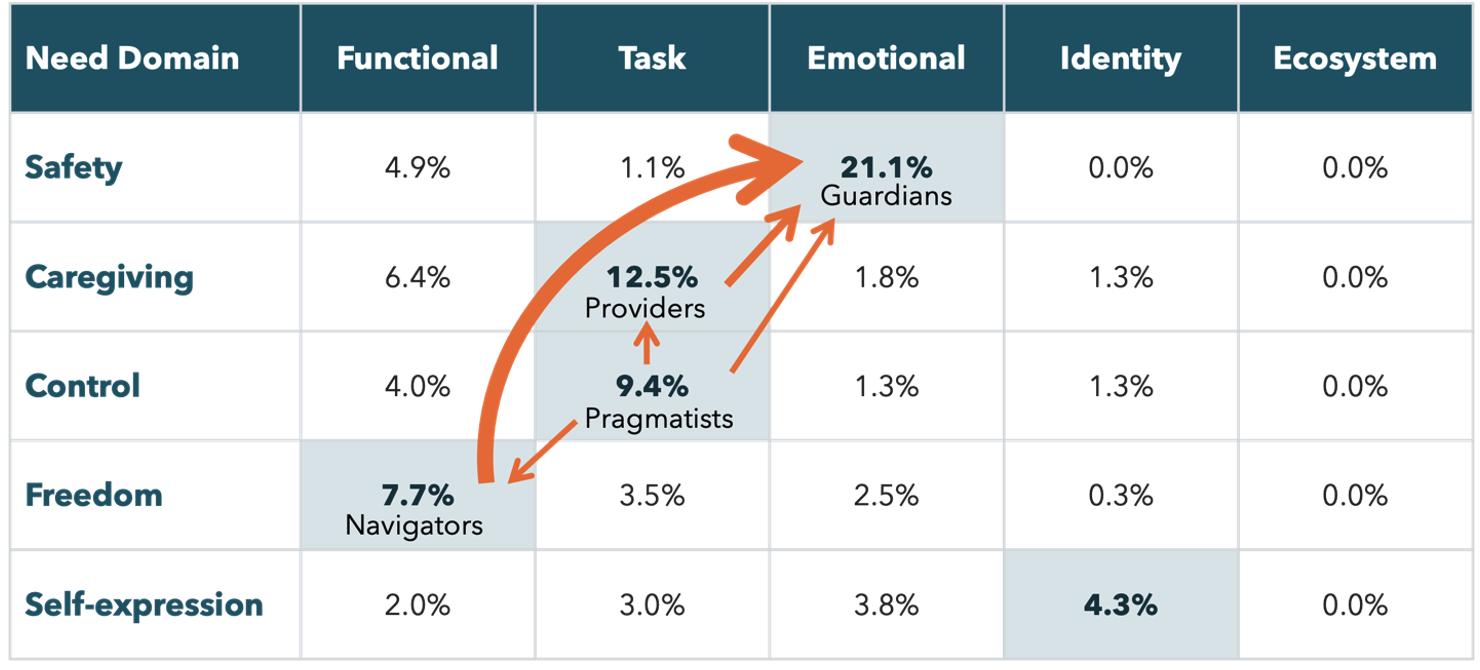
About the migration analysis: Migration cannot be observed directly in a single research wave. Direction and timing were inferred from each respondent’s full motivational profile — how strongly their dominant motivation is established (“competing motivations” refers to consumers whose top two motivations are close in strength) and how attracted they are to alternative Motivational Territories. Figures are directional estimates pending a tracking wave.
The migration analysis reveals that personas differ not only in what motivates them today, but also in how stable those motivations are over time. The Guardians and the Providers are the market’s most stable personas — once consumers adopt a prepaid card for these reasons, they tend to maintain those motivations. Some Providers, however, gradually evolve from providing for others to protecting them, incorporating Safety into their core motivation.
The Navigators often adopt a prepaid card for its travel benefits, but many later shift toward reassurance and online safety. The Pragmatists are the least stable persona, typically adopting a prepaid card to solve a specific problem before moving on to other motivations.
The Strategic Priorities
Looking at the market through both a static and a dynamic lens transforms a map of demand into a roadmap for growth.
- The static view identifies where unmet demand exists today.
- The dynamic view reveals how personas evolve, where customers are moving, and which opportunities are likely to grow or decline over time.
Together, they allow organizations to distinguish between primary growth opportunities, acquisition opportunities, emerging opportunities, and mature, highly contested markets.
Primary Opportunity: The Guardians (Acquisition & Growth)
The stable, underserved demand-generating persona occupying the market’s strongest growth territory.
- Their dominant motivation accounts for 76% of their overall motivational profile, and only 12% show competing motivations, making them the most stable persona in the category.
- Even more importantly, Safety @ Emotional is not only the largest Motivational Territory (21% of demand), but also the market’s strongest area of attraction. Consumers from almost every other persona show their strongest pull toward this territory, meaning more people are gradually moving toward this Motivational Territory than away from it.
Strategic implication: Build a prepaid card around emotional reassurance rather than simply security features. Design the value proposition primarily for the Guardians while ensuring it also resonates with other personas gradually moving toward this Motivational Territory.
Secondary Opportunity: The Navigators (Acquisition & Retention)
The easiest point of market entry with strong long-term growth potential.
- The Navigators are typically younger, highly mobile consumers, adopting prepaid cards for Freedom @ Functional — travel convenience, multiple currencies, and practical utility.
- The migration analysis shows that this persona gradually shifting toward the Safety @ Emotional territory within 12–18 months, as reassurance and online safety become more important than travel convenience.
Strategic implication: Continue using travel convenience as the primary acquisition value proposition, but gradually introduce a safety-focused positioning to strengthen long-term engagement and retention.
Future Opportunity to Monitor: The Emerging Persona — Self-Expression @ Identity
A genuine white-space opportunity with meaningful latent demand.
Although only 4% of consumers currently occupy this Motivational Territory, nearly 18% already show interest in an identity-expressive prepaid card while currently belonging to another persona.
Strategic implication: Monitor rather than invest. Track how the territory evolves, but wait until the market reaches sufficient scale before launching a dedicated product.
Lower-Priority Personas
The current market structure suggests that The Providers and The Pragmatists are less attractive targets for new prepaid card entrants. Existing Canadian prepaid cards already compete heavily for these personas. These are also the territories that customers are most likely to leave, making them mature, highly contested markets with limited opportunities for differentiation and long-term growth.
The Providers are a mature and stable persona. Only 16% show competing motivations, and their dominant motivation is unlikely to change within the next year. When it does, it typically shifts toward the Guardian mindset, as the desire to provide gradually evolves into the desire to protect.
Avoid competing directly in the mature gifting space.
The Pragmatists are the least stable persona in the category. Their dominant motivation accounts for only 56% of their overall motivational profile, while 44% show competing motivations — the highest proportion of any persona. They typically adopt prepaid cards to solve a specific budgeting or money-management problem before moving toward other motivations.
Avoid building a long-term positioning around this group. Products focused primarily on budgeting and money management may acquire customers but often struggle to retain them.
What This Proof of Concept Demonstrates
The static view identified two underserved opportunities: The Guardians and Self-expression. Adding the dynamic view not only strengthened the business case for both but also revealed a third opportunity—the Navigators—whose evolving motivations make them an ideal target for customer acquisition and long-term retention.
Together, the static and dynamic views show that successful prepaid card strategies should be built not only around where demand exists today, but also around where customer motivations are heading.
From Structure to Dynamics
Need Architecture explains the structure of demand. Persona Architecture explains the dynamics of demand. Together they provide a foundation for designing products and value propositions that not only satisfy today’s customer needs but also remain relevant as those needs evolve over time.
Markets evolve because people evolve. Persona Architecture helps us understand both.
But understanding demand is only the beginning. The next question is how to design products that evolve with customers rather than simply satisfy today’s needs. That is the focus of the next Demand Architecture module: Product & Value Proposition Architecture.